AgentsAboard vs Zapier: rules you build, or agents that tell you what matters
With Zapier you write “when this happens, do that”, and it works great when you know what to watch. AgentsAboard starts from the other end: you connect your tools, the agents read what's happening across all of them and hand you, in order, what needs your decision.
| What | Zapier | AgentsAboard |
|---|---|---|
| How you start | You build a zap for every alert: trigger, filter and action | You connect Stripe, Search Console, GitHub or your server; there are no workflows to build |
| What you get | One message per event, in the channel you pick | One list a day, urgent first |
| Who decides what matters | You, when you write each rule | The agent, from context: a dispute with a deadline beats a routine charge |
| Things across tools | You chain steps by hand | One agent sees payments, traffic, code and server for the same project |
| What can't be undone | Runs as soon as the rule fires | Waits for your one-click OK: refunds, deletions, messages to clients |
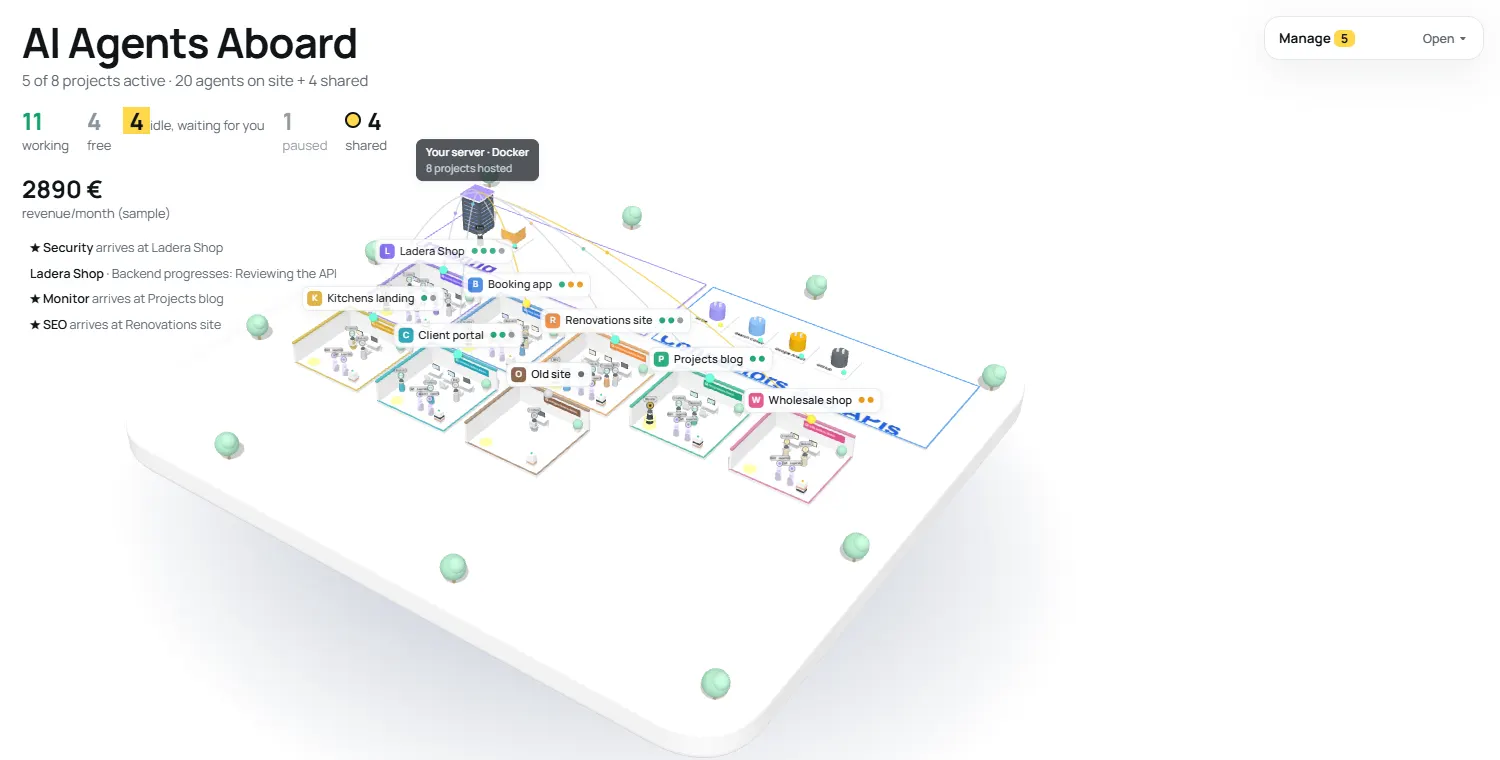
| Several projects | A set of zaps per project | Each project is an office in the same 3D view |
Better with Zapier
- Connecting thousands of apps to each other
- Automating a fixed process you already know step by step
- Moving data from one place to another hands-off
Better with AgentsAboard
- Knowing every morning what needs your decision across all your projects
- Not losing a Stripe dispute or a site outage among a hundred alerts
- Letting AI act alone only on what can be undone
They don't exclude each other: plenty of people use Zapier to move data and AgentsAboard to have someone look at the whole picture and tell them what to do.
Questions
Does AgentsAboard replace Zapier?
If you mostly use Zapier to get alerts from Stripe, your server or Google, yes: AgentsAboard gives them to you ranked, with nothing to build. If you use it to move data between apps, no: that's still its job.
Do I have to write rules?
No. You connect each tool with a read-only key and the agents already know what to look at.
How much does it cost compared to Zapier?
The first 14 days are free, no card. After that, Pro is €39 a month plus VAT, with $15 of AI a month included and no lock-in.
Other comparisons
See it in 3D
The office of a sample business: each building is a project and each person an agent. Spin it and tap a building.
Stop checking ten tabs every morning.
Start freeNo card · 5 minutes